Linear Equations
1. Explain linear equations and provide the general expression.
- Definition: A linear equation represents a straight line when graphed on a coordinate plane in which the highest power of any variable is 1. Every term will be either a constant or a factor of a constant with a first order term.
- General Expression: $y = mx+b$, where
- $m$ and $b$ are constants.
- $x$ represents the variable
2. Define the term intercept.
Intercept is a point where a line crosses an axis.
3. Provide the methods to find the $x$ and $y$ intercepts.
- Set $y = 0$ to find x-intercept.
- The x-intercept of a line is the point where the line crosses the x-axis. This means that the y-coordinate of the x-intercept is always 0.
- Set $x = 0$ to find the y-intercept.
- The y-intercept of a line is the point where the line crosses the y-axis. This means that the x-coordinate of the y-intercept is always 0.
4. Explain the term slope and how to calculate it. Provide the formula.
- Definition: The rate of change (steepness) between Y and X.
- Calculation: It is calculated by dividing the change in the y-coordinate of two points on the line by the change in the x-coordinate of the same two points.
- Formula: $\frac{\Delta Y}{\Delta X}, \frac{Y_2-Y_1}{X_2-X_1}$
5. Describe the concepts of positive and negative slope in relation to the $x$ and $y$ coordinates.
- Positive Slope: For every increase in $x$, $y$ increases.
- Negative Slope: For every increase in $x$, $y$ decreases.
6. Explain the phrase “The unit of change of $y$ with respect to $x$ is ..”
The phrase means describing how the quantity $y$ changes for a corresponding change in $x$
7. Explain horizontal and vertical slopes.
- A horizontal slope occurs when there is no variation in Y as X increases, indicating a slope of 0.
- A vertical slope occurs when there is no variation in X as Y increases, resulting in an undefined slope.
8. Provide the standard form for a linear equation with two variables.
$ax+by=c$, where..
- $a,b$ are constants, real numbers and not equal to 0.
- $x$ and $y$ are the variables.
9. How many solutions to a linear equation in two variables?
There are always infinitely many solutions to a linear equation in two variables.
10. Given the linear equation $ax+by=c$. Provide a simple solution to determine two points.
To identify the two points, solve the equation by substituting 0 for $x$. For the next point, substitute 0 for $y$ again.
11. Given, $ax+by = r$, if $b = 0$, what will be the set of solution be?
$ax = r, x = \frac{r}{a}.$ The set of the solution is restricted the $x$ variable to be equal to $\frac{r}{a}.$, which is a constant.
12. Explain system of linear equations.
A system of linear equations is a collection of two or more linear equations.
13. What does it signify when a system of linear equations can possess one solution, no solutions, or an infinite number of solutions?
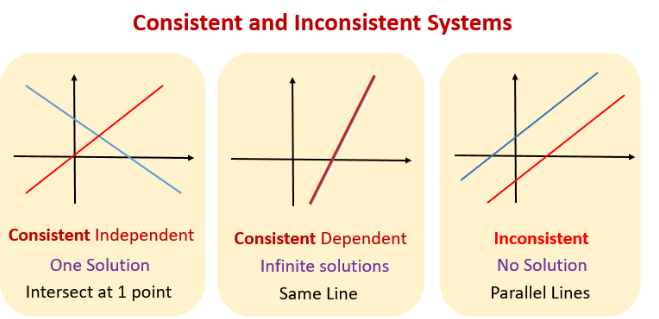
- A system of linear equations with one solution has a unique intersection point.
- A system of linear equations with no solutions is inconsistent.
- A system of linear equations with infinitely many solutions has overlapping lines.
14. Explain the elimination method in steps to solve system of linear equations.
Eliminate one variable to solve to the other.
- Multiply or divide one or both equations to make one of the variables equal in both equations.
- Add or subtract to eliminate one of the variables.
- Solve the remaining variable.
- Substitute the solved variable into one of the original equation.
15. Explain the substitution method in steps to solve system of linear equations.
Substitute the other constraint (equation) into the other equation vice-versa.
- Solve one equation for one variable.
- Substitute one expression into the other equation and simplify the equation.
- Substitute the solved variable into one of the original equation to find the other variable.
16. Explain the difference between independent or dependent in a system of linear equations.
- Independent equations means the equations don’t affect each other’s solution
- Dependent equations have solutions that are connected or influenced by each other.
17. Explain consistent and inconsistent system of equations.
- Consistent equations have at least one solution. Whereas, inconsistent equations do not have a solution.
18. Explain dependent and independent system of equations using slope or intersection.
- A system of equations is dependent if it has infinitely many solutions, all of which form a linear relationship with each other.
- Both equation have the same slope and same $y$ and $x$ intersection.
- A system of equations is independent if it has a unique solution, meaning there is only one set of values for the variables that satisfies all equations in the system.
- Both equation have different slope but the lines will intersect at one $(x,y)$ value.